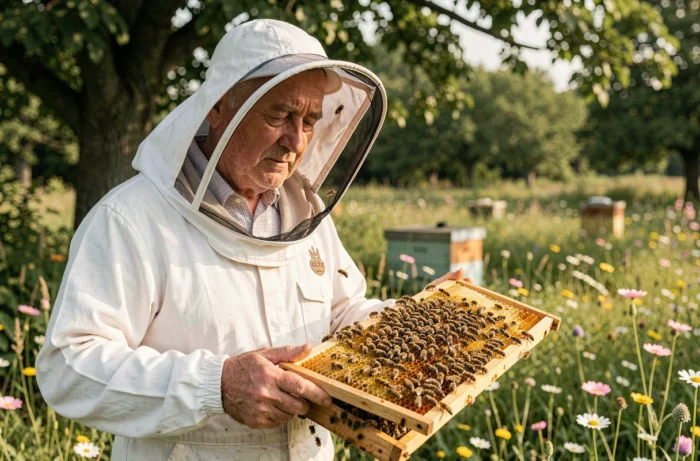
Bees have been part of daily life for millennia. Long before the invention of modern hives, humans were already harvesting honey from rock cavities. This relationship between humans and bees is not limited to honey production: it directly affects the reproduction of the majority of flowering plants and, by extension, a large part of our food supply.
Crop Pollination: Why Bees Are Irreplaceable
Have you ever noticed that an isolated apple tree in a garden produces fewer fruits than an apple tree surrounded by wildflowers? It’s no coincidence. Bees transport pollen from flower to flower, enabling plant fertilization. Without this transfer, many fruits and vegetables simply would not form.
According to beekeeping experts from the Food and Agriculture Organization of the United Nations, one third of global food production depends on bees. Pollinators as a whole (honeybees, wild bees, bumblebees, butterflies) directly contribute to food security. Nearly three-quarters of the plants that produce the world’s food need this external help to reproduce.
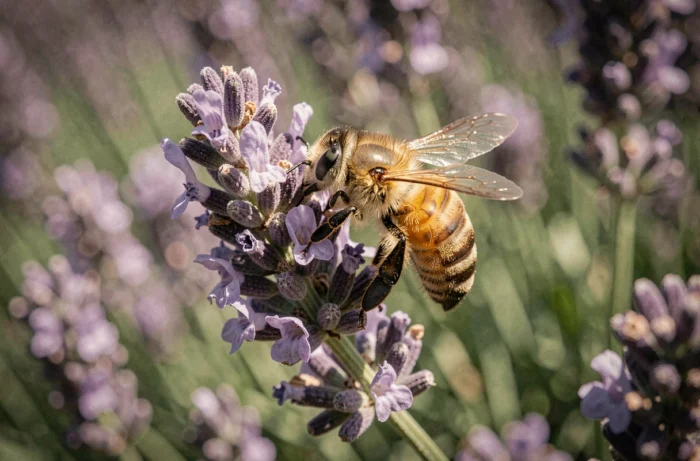
What distinguishes the honeybee from other pollinating insects is its floral constancy: when it forages on a particular plant species, it remains loyal to it throughout its outing. This behavior makes pollination much more efficient than the random visits of a generalist insect. Beekeepers who place their hives near orchards or rapeseed fields participate, through Hommes Et Abeilles, in this targeted pollination dynamic that benefits both crops and colonies.
Wild Bees and Domestic Bees: Two Distinct Realities
When we talk about bees, we often think of the honeybee, the one that lives in hives and produces honey. But wild species represent a much broader diversity. In Europe, there are several hundred species of wild bees, each adapted to specific habitats and flowers.
Wild bees provide a major part of the pollination that the domestic bee does not cover. Some wild species are the only ones capable of pollinating deep-cupped flowers, which are inaccessible to the honeybee. Their decline therefore affects plant reproduction chains that beekeeping cannot compensate for.
The coexistence between domestic and wild species is not always simple. In some areas, a high density of hives creates competition for floral resources. Wild bees, which are less mobile and fewer in number, then find themselves in difficulty. Managing this coexistence is one of the challenges of contemporary beekeeping.
Pesticides and Pollinators: A Sawtooth Trajectory
Chemical pesticides are among the leading causes of colony mortality. Why is this issue still so complex? Because the data evolves rapidly and does not all point in the same direction.
The harmonized risk indicators from the European Union show a significant long-term decrease in the use of chemical pesticides, by more than half between the reference period of 2015-2017 and 2024. This trend initially raised hopes for a lasting respite for pollinators.
The most recent data nuance this observation. In 2024, risk indicators rose by a few percentage points compared to 2023, and total pesticide sales in the EU increased compared to the previous year. This modest rise shows that the reduction trajectory is neither linear nor guaranteed.
NGOs and researchers are warning about another risk: ongoing regulatory reforms could reduce the EU’s ability to adjust its rules based on new scientific knowledge about the effects of molecules on bees. A less responsive regulatory framework could hinder the protection of pollinators at a time when warning signals are re-emerging.
Dryness and Honey Production in France
Pesticides are not the only threat. Increasingly frequent droughts reduce flowering and thus the food resources of colonies. In France, recent drought episodes have caused significant drops in honey production, weakening both bees and beekeepers.
Biodiversity in France: What the State of Pollinators Reveals
The state of biodiversity in France continues to deteriorate. Wild pollinators are among the most affected species groups, with a documented decline over several decades. This decline is not limited to intensive agricultural areas: urban and peri-urban environments are also affected by the reduction of natural habitats.
Several factors are compounding:
- The disappearance of hedges, meadows, and fallow land that provided wild bees with nesting sites and diverse pollen sources
- The expansion of the Asian hornet, a formidable predator of honeybees, which exerts additional pressure on already weakened colonies
- The simplification of agricultural landscapes, where monoculture replaces mosaics of varied crops that pollinators depend on
Protecting pollinators requires acting on their entire environment, not just on the hive. Planting flowering hedges, maintaining flowering strips along field edges, and limiting mowing of urban green spaces: these actions create ecological corridors that allow bees to feed and move.
Urban Beekeeping: A Misguided Idea?
Setting up hives in the city has become a symbolic gesture of support for biodiversity. The reality is more nuanced. Multiplying hives in urban areas without sufficient floral resources exacerbates competition between domestic and wild bees. Before adding hives, the priority should be to green spaces with a variety of flowering plants that bloom throughout the season.
The relationship between humans and bees is at a turning point. The decline of pollinators is not a fatality, but solutions require concrete choices at the level of each territory: balancing agricultural intensification and ecosystem maintenance, adapting regulations to recent scientific data, rethinking the place of nature in the spaces we design. What is at stake around bees goes far beyond the hive.