Between the reformulations imposed by European regulations on microplastics and the rise of concentrated formulas with a reduced spectrum, this year’s beauty trends are not just about a change in palette. They reflect a shift in priorities: fewer products, rethought textures, and regulatory constraints that are significantly altering the composition of skincare for the face and body.
Microplastics Regulation and Reformulation of Cosmetics: What Changes for Your Routine
Most articles on beauty trends mention “clean beauty” as a consumer choice. The actual framework is more stringent. The Regulation (EU) 2023/2055, which came into effect in October 2023, imposes a precise timeline for banning synthetic polymer microparticles in cosmetics sold in Europe.
Deadlines vary by product category, and this staggered progression is reshaping the available offerings on shelves.
| Product Category | Ban Deadline | Impact on Routine |
|---|---|---|
| Rinse-off products (cleansers, scrubs, shampoos) | October 17, 2027 | Disappearance of plastic exfoliating microbeads |
| Leave-on products (creams, milks, lotions) and fragrance capsules | October 2029 | Reformulation of textures and diffusion systems |
| Makeup, lipsticks, nail products | October 2035 | New formulation bases for makeup |
This timeline explains why brands are already reformulating their scrubs and facial cleansers. Plastic texturizing agents are being replaced by mineral or plant-based alternatives. For consumers, this translates to slightly different textures, sometimes less “smooth,” but with the composition becoming genuinely cleaner due to legal obligation.
Routines relying on body products or facial care containing synthetic glitter or micro-encapsulated fragrances will also need to evolve within a few years. This is not a style trend; it is a regulatory fact.
Skinimalism Trend: Reducing Your Beauty Routine Without Losing Effectiveness
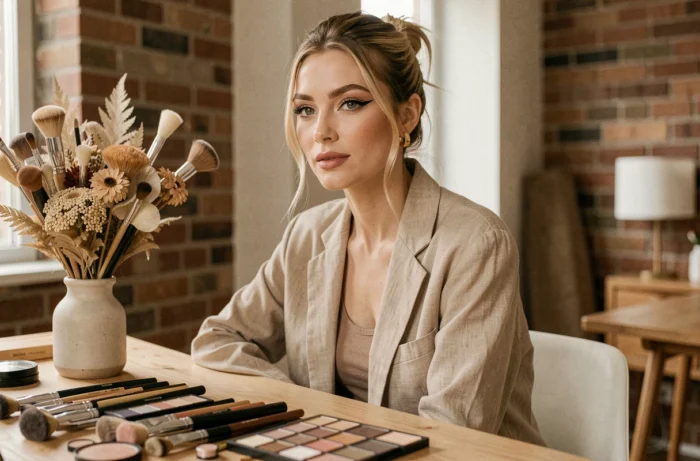
Skinimalism involves reducing your skincare routine to three, four, or five products at most, favoring concentrated formulas that replace multiple steps. Several elements distinguish this approach from beauty trends that, from Korean layering with ten steps to decades of serum-cream-oil sequences, have often encouraged product accumulation.
On By Julie’s beauty section, feedback on this type of simplified routine confirms a shared observation among many users: the skin tolerates a smaller number of well-chosen products better than a layering of treatments with sometimes conflicting active ingredients.
The principle is based on three concrete axes:
- Selecting a cleanser suitable for one’s skin type and sticking to it, rather than alternating between several formulas over the weeks.
- Opting for a multifunctional serum (hydration, radiance, firmness) that replaces the combination of serum + day cream + primer.
- Keeping only one daily sunscreen product, applied as the last step, without unnecessary intermediate layers.
Fewer products also reduce the risk of skin sensitization. Each added formula multiplies the preservatives, fragrances, and emulsifiers in contact with the skin. A three-product routine mechanically contains fewer potential allergens than an eight-step sequence.
Makeup and Skincare Merged: The Daily Makeup-Skincare Trend
The boundary between makeup and skincare continues to blur. Foundations enriched with hyaluronic acid or niacinamide are not new, but the current trend goes further: formulations now integrate skincare actives at truly functional dosages, not just for marketing purposes.
What we observe in the market this season:
- BB and CC creams whose UV filter concentration matches that of a real sunscreen, making the SPF step distinctly optional for daily urban use.
- Lipsticks formulated with nourishing plant oils that replace lip balms in the routine.
- Compact powders containing probiotics or prebiotics aimed at preserving the skin microbiome.
Makeup-skincare eliminates steps instead of adding them. This is what distinguishes this trend from a mere commercial argument: the hybrid product replaces two references in the kit, not just one.
Rethought Textures and Formulas for Spring
The season also pushes towards lighter textures. Rich winter creams give way to gel-creams or aqueous serums that are better suited to rising temperatures. The desired look is a “fresh skin” effect with minimal layering.
Shades follow the same movement: more transparent pigments, satin finishes rather than matte, liquid blushes that blend into the skin with the fingers. Spring makeup approaches skincare in both gesture and composition.
Fragrance and Sensory Beauty: Beyond the Face
Beauty routines increasingly incorporate fragrance as a complete skincare gesture. The trend towards personalized fragrances, often described as “therapeutic” or “emotional,” is based on the idea that olfactory choice influences mood and self-perception on a daily basis.
What is changing concretely: micro-encapsulated fragrance capsules will need to be reformulated before October 2029 due to the European regulation on microplastics. Long-lasting diffusion systems based on synthetic polymers will gradually disappear, pushing fragrance houses to return to more classic infusion techniques or develop biodegradable alternatives.
For consumers, this means that the longevity of a fragrance on the skin could evolve. Some brands are already compensating by concentrating their scents more or offering “fragrance care” formats (body oil, hair mist) that extend diffusion without resorting to plastic micro-encapsulations.
This year’s beauty trends are reflected as much in the formulas as in the regulatory texts. The next reformulation of your favorite scrub or lipstick will not be a brand whim, but a compliance with an already ongoing European timeline.