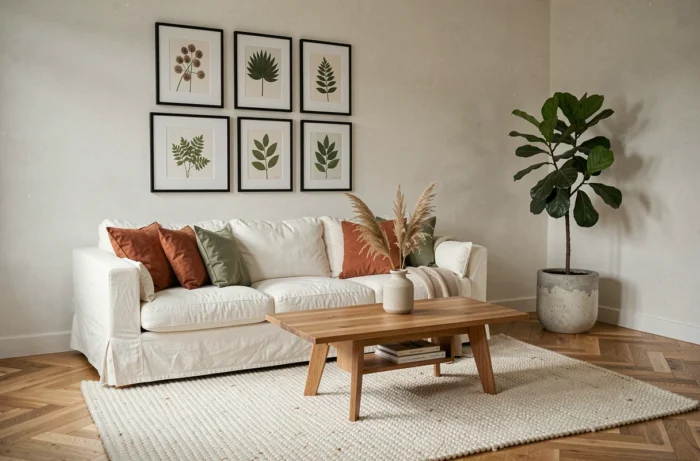
Transforming an interior is not just about changing a sofa or repainting a wall in off-white. Recent data reveals an underutilized fact: more than one in two French people feel demoralized when faced with clutter as soon as they enter their home, and 39% regret not being able to showcase their memories or passions due to lack of space.
What decorative levers produce a measurable effect on perceived well-being, and which are merely trends?
Colour drenching: chromatic saturation versus classic accent wall
The technique of colour drenching, documented by the French decor press as a major trend in 2025, involves applying a single shade throughout a room: walls, ceiling, baseboards, woodwork, and sometimes even radiators. The result is radically different from a simple accent wall.
| Criterion | Accent Wall | Colour Drenching |
|---|---|---|
| Painted Surface | One wall | The entire room (walls, ceiling, woodwork) |
| Spatial Effect | Draws the eye to a focal point | Blurs the boundaries of the room, visually enlarges |
| Implementation Difficulty | Low (half a day) | Medium (preparation of all surfaces) |
| Main Risk | Imbalance if the color clashes with the rest | Monotony if the furniture does not create contrast |
| Suitable for Small Rooms | Yes, but limited effect | Yes, eliminates visual fragmentation |
Colour drenching works particularly well in spaces of less than 12 m² (entryway, office, bathroom) where the multiplication of shades visually fragments the volume. In contrast, in a large open living room, total saturation can overwhelm the furniture if it remains in neutral tones.
To explore Happy Space’s decor ideas, which integrate this chromatic approach into concrete layouts, it should be noted that the choice of finish (matte, satin, glossy) radically alters the final appearance of a drenching. A matte-finished ceiling absorbs light, while satin woodwork reflects it and creates depth.
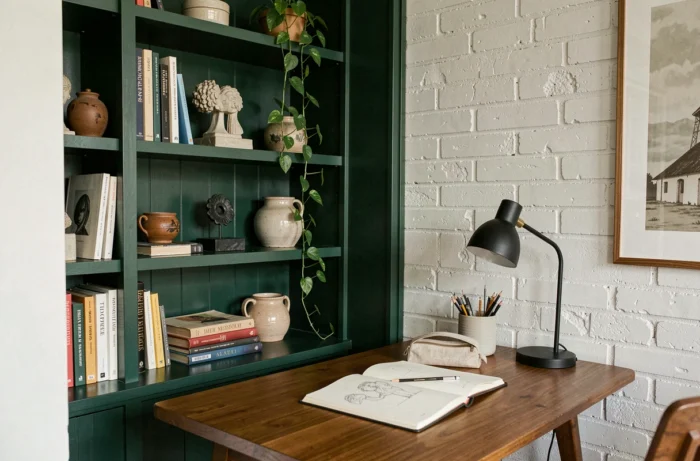
Biophilic decoration: beyond potted green plants
Biophilic decoration is emerging in 2025-2026 as a fundamental trend, not just an addition of plants on a shelf. Interior design professionals describe it as a holistic approach that integrates raw materials, framed natural light, and deliberately oriented views to the outside.
Three concrete axes of biophilia applied to decor
- The stabilized green wall: unlike live plants that require regular maintenance, stabilized plants (moss, ferns, eucalyptus) retain their appearance without watering or direct light, making them suitable for windowless rooms or dark corridors.
- Untreated raw materials: natural stone as a kitchen backsplash, driftwood as a headboard, terracotta flooring. The idea is to showcase the imperfections of the material rather than hide them under a finish.
- Framing natural light: repositioning a desk or reading nook facing a window, installing a mirror opposite the opening to double the luminous depth. Oriented natural light reduces visual fatigue much more than any supplementary lighting.
Biophilia does not work through accumulation. An interior that piles up plants, wood, stone, and jute in every room produces the opposite effect: sensory overload. The principle relies on selecting two or three natural elements per space, allowing them to breathe.
Decor ideas for the living room and office: the trap of multifunctional furniture
With the permanence of remote work, many households have sought to merge workspace and living space. Multifunctional furniture (a coffee table that transforms into a desk, a shelf that serves as a partition) seems like an elegant solution. In practice, a piece of furniture that does everything does nothing correctly over time.
The true lever for transforming a living-office space lies in visual separation, even if symbolic. A differently colored rug under the work area, a dedicated light fixture with a cooler color temperature, or a simple change in wall covering is enough to create two distinct mental zones without physically partitioning.
Interior design and space management: what the data suggests
The link between layout and well-being is not merely a matter of aesthetic preference. Neuroarchitecture, a research field that intersects neuroscience and space design, studies how shapes, colors, and spatial arrangement influence physiological responses.
Cluttered or poorly zoned spaces generate measurable stress, which aligns with the observation that the majority of French people associate visible disorder with decreased morale. For a standard-sized living room, the most effective rule is that of free passage: maintain at least 80 cm between each piece of furniture to allow for smooth circulation.
Personalized decor style: displaying your objects without falling into clutter
French people who regret not being able to display their memories or passions point to a methodological issue, not a space issue. The curation of personal objects follows the same principles as exhibition scenography.
- Group by theme or color: three travel objects on a tray form a composition. The same three objects scattered throughout the room create visual noise.
- Vary heights: a frame placed on the floor next to a vase on a console and a wall shelf creates a visual triangle that the eye naturally traverses.
- Leave empty space: a shelf filled to 70% appears more polished than a full shelf. Empty space is a legitimate decorative element.
- Rotate objects: changing the display every two to three months renews the perception of the space without any purchases.
Personalizing an interior does not come from accumulating Pinterest trends. It comes from the ability to select, remove, and embrace choices that may not please everyone. An interior that resembles its occupant is one where certain pieces remain deliberately stripped down while others concentrate the entire personality of the home.