Finding a formula capable of concealing imperfections without turning the face into an opaque and frozen surface remains the main point of tension when choosing a foundation. The question has changed over the past few seasons: the desired coverage is no longer that which erases the skin, but that which evens it out while keeping its texture visible. This guide measures the concrete differences between textures, finishes, and formulations to identify what truly works on different skin profiles.
Buildable coverage or fixed high coverage: what formulas really allow
Classic guides oppose light coverage and full coverage as two distinct categories. Recent formulations blur this boundary. Versatile fluid foundations allow for a transition from a light finish to a more intense one by layering thin coats, without a cardboard effect.
The principle is based on a high concentration of natural pigments (notably iron oxides) dispersed in a lightweight base. The result: a first layer that unifies, a second that corrects locally, without ever reaching the opacity of a classic high coverage formula.
Choosing a covering and natural foundation therefore requires checking if the formula allows for this gradual increase in coverage, or if it imposes a fixed level from the first application.
| Type of coverage | Visual result | Suitable profile | Main limitation |
|---|---|---|---|
| Light (unifying veil) | Visible skin, apparent texture | Clear skin, diffuse redness | Does not conceal marked spots |
| Buildable (layering) | Second skin, preserved skin texture | Localized imperfections, light dark circles | Requires precise application technique |
| Fixed high coverage | Smooth and uniform surface | Scars, active acne, hyperpigmentation | Mask effect if poorly dosed, variable wear on oily skin |
Buildable coverage represents the most sought-after compromise for achieving a natural result. Fixed high coverage formulas remain relevant on targeted areas (concealer), not necessarily on the entire face.
Fluid, serum, or cream texture: comparison of finishes on real skin
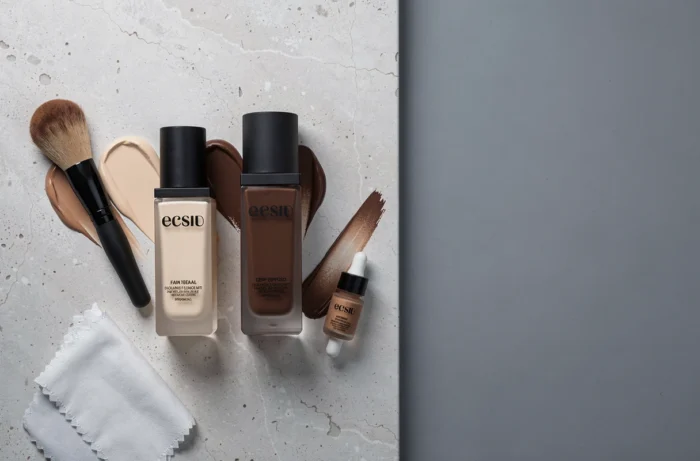
The texture determines both the final result and the level of coverage. Three main families dominate the market, with very different behaviors depending on skin type.
Fluid foundation
The most common formula, the fluid offers quick application and a generally satin finish. It is suitable for most skin types. On oily skin, it may require setting powder in the T-zone after a few hours.
Serum foundation
Serum foundations incorporate moisturizing active ingredients into a very liquid base. The finish is luminous, close to a tinted moisturizer, with light to medium coverage. This format works particularly well on dry or mature skin looking for a plumping effect without visible material.
Cream foundation
The cream contains more pigments and fatty substances. It provides medium to high coverage, with a more opaque finish. On combination skin, the T-zone can shine quickly. Dry skin benefits the most from this texture due to the lipid barrier it leaves behind.
- Oily skin: prefer a mattifying fluid or a mineral powder that absorbs sebum without clogging pores
- Dry or mature skin: opt for a tinted serum or a cream enriched with plant-based moisturizing actives
- Combination skin: a buildable fluid applied with a brush, with targeted concealer on imperfection areas, offers the best balance
- Sensitive skin: check for the absence of synthetic fragrances and occlusive film-formers in the INCI list
Skin undertone and iron oxides: the shade should not be chosen by eye
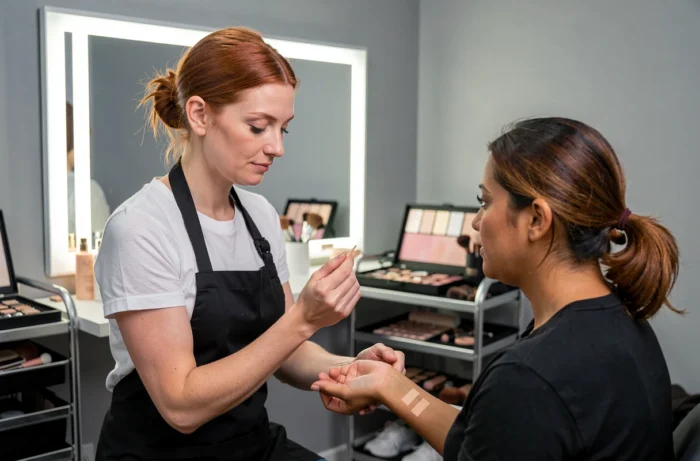
The color of the foundation is based on a mix of iron oxides (yellow, red, black) whose proportions determine the final shade. Testing a shade on the back of the hand does not provide any reliable indication: the complexion of the face and that of the hand differ significantly in most people.
The reliable test is done on the jawline, at the junction between the face and neck, in natural light. If the demarcation disappears after a few seconds of drying, the shade matches.
The undertone (warm, cool, neutral) further refines the choice. A simple method: observe the veins on the inner wrist. Greenish veins indicate a warm undertone. Bluish veins signal a cool undertone. A mix of both indicates a neutral undertone, compatible with most ranges.
Brands that offer a high number of shades (sometimes several dozen) make matching easier. However, a natural foundation with few shades may require mixing two shades to achieve the right color, which remains a common practice among professional makeup artists.
European regulation and composition: what changes for covering formulas
The European Union has recently introduced strict limits on the concentration of vitamin A (retinol and derivatives) in cosmetic products, including foundations and tinted products. This measure directly affects formulas that incorporate retinol as an anti-aging active ingredient in their coverage base.
Foundations containing retinol will need to comply with reduced concentration thresholds, which may alter the claimed efficacy of certain “care + makeup” formulas. For consumers seeking an anti-aging effect combined with coverage, it becomes relevant to separate the care (retinol serum applied beforehand) from the covering foundation.
Furthermore, the regulation imposes more detailed allergen labeling on packaging. Reading the INCI list remains the most reliable reflex to avoid irritants, particularly on reactive skin that does not tolerate fragrances and harsh preservatives well.
Ultimately, the choice of a covering and natural foundation hinges on three verifiable parameters: the formula’s ability to build coverage without a plaster effect, the compatibility of the texture with the skin type, and the accuracy of the shade tested in natural light on the jawline. Everything else is marketing.