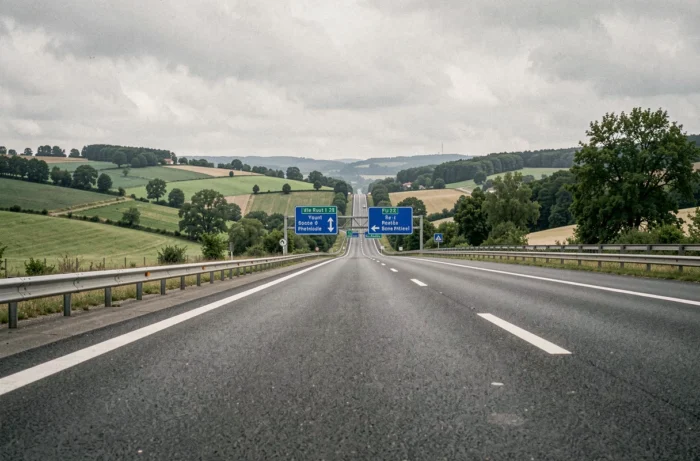
Every summer, millions of drivers travel across France, discovering along the way that some highways charge no tolls. This free network represents about a quarter of the French highway system, covering nearly 3,000 kilometers. Knowing where these toll-free sections are can significantly change the cost of a long-distance trip, especially when making round trips between two regions.
Free-flow tolls: what changes on the ground in 2026
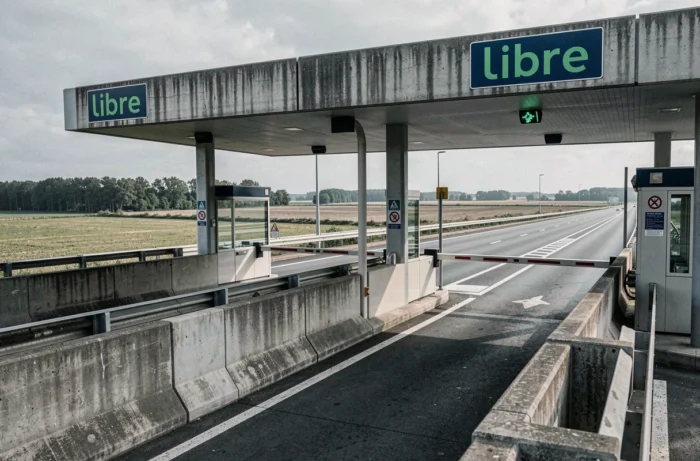
You may have noticed that some toll booths have disappeared. On routes like the A13 and A14, tolls now operate in free flow, without physical barriers. Gantries equipped with cameras and sensors read license plates or the toll badge as vehicles pass through.
The change is more than just aesthetic. You now have to pay afterward if you don’t have a badge. Forgetting to pay results in a surcharge, followed by a fine. This system alters habits: you no longer slow down at a booth, but you must check that the payment has been recorded.
The transition to free flow also generates construction work. In Normandy, nighttime construction on the A13 disrupts traffic for several weeks. These temporary ramp closures also affect the A31 in Lorraine. The removal of physical tolls does not mean the absence of constraints: it shifts the challenges from paying at the booth to managing the payment administratively and dealing with disruptions caused by construction.
To pinpoint the exact free sections and routes affected by free flow, a free highways map in France 2026 allows you to visualize the network before planning a route.
Toll-free highways in France: where to drive without tolls
Toll-free highways are referred to as “non-conceded.” They are financed and maintained directly by the State, without delegation to a private operator. Paid highways, on the other hand, are operated by concessionaires like Vinci Autoroutes, Sanef, APRR, or ATMB, who collect tolls in exchange for maintaining and modernizing the infrastructure.
Completely free major routes
The A75, which connects Clermont-Ferrand to Béziers, remains the best-known example. Only the Millau Viaduct, operated separately, charges a toll. The rest of the route crosses the Massif Central without any tolls, for several hundred kilometers.
Other long routes are also free:
- The A20 between Vierzon and Brive-la-Gaillarde, a popular route to reach the southwest without going through the toll A10.
- The A84, nicknamed the Estuaries Highway, which connects Caen to Rennes while crossing Normandy and Brittany.
- The A34 in the Ardennes, linking Reims to Charleville-Mézières, useful for connections to Belgium.
Urban bypasses and free sections
Most ring roads around major cities are free: the Paris ring road, the bypasses of Bordeaux, Lyon, Toulouse, or Nantes. These urban sections are managed by the State or local authorities.
Some paid highways also have free sections, particularly near urban areas. This is the case on the A10 near Tours or on the A63 in the Landes. Identifying these portions before departure can sometimes help avoid a toll by exiting at the right interchange.
Eurovignette Directive 2026: an impact on tolls for electric vehicles
The European reform of the Eurovignette, applicable from July 1, 2026, introduces a new possibility. Zero-emission vehicles may be exempt from the “infrastructure” component of tolls. For low-emission vehicles, reductions of up to 75% are possible.
Note: this measure is not automatic. Each country decides whether to transpose it into its national law. In France, no generalization of this exemption has been announced for major concessioned networks. No implementation timeline has been communicated at this stage by the French authorities.
In practical terms, driving an electric car on a concessioned highway does not guarantee a toll reduction in 2026. The directive opens a door, but the actual benefit will depend on negotiations between the State and the concessionaires.
Planning a mixed free and paid trip: method and tools
Combining free and paid sections requires some preparation, but the financial gain can be substantial on a trip of several hundred kilometers.
The first step is to identify the free sections on your route. Route calculators like ViaMichelin or Waze offer an “avoid tolls” option. The result sometimes extends the journey by a few tens of minutes, but eliminates the toll cost.
A trip from Paris to Montpellier via the A75 avoids almost all tolls by going through Clermont-Ferrand instead of Lyon and the Rhône Valley. The driving time is comparable, and crossing the Massif Central offers landscapes not seen from the A7.
Some points to check before leaving:
- Current construction on free routes, as ramp closures may force a paid detour.
- The cost of the Millau Viaduct if you take the A75, the only toll point on this route.
- The availability of gas stations and rest areas, which are less frequent on some non-conceded sections.
- Traffic conditions near urban areas, where free bypasses can be congested during peak hours.
The network of free highways in France remains stable from year to year, but payment methods and construction work evolve. The arrival of free flow on new routes and the future transposition of the Eurovignette directive could change travel habits. Consulting an updated map before each long trip remains the most reliable reflex to balance time, budget, and driving comfort.