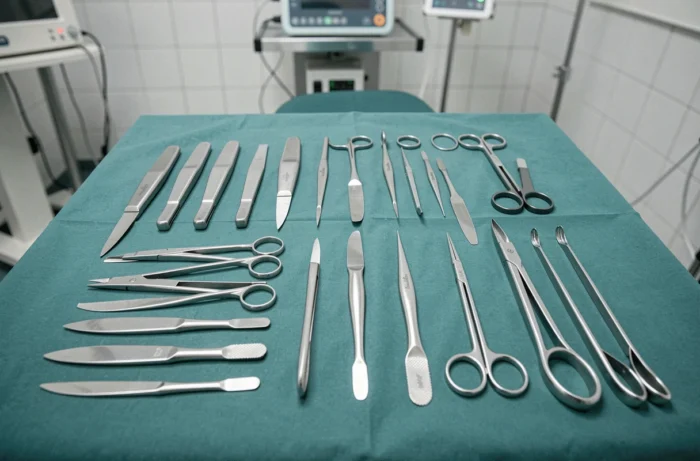
Surgical equipment refers to all the instruments, consumables, and equipment used in the operating room to perform a procedure. Each tool serves a specific function in the surgical chain, from the initial incision to the closure of tissues. The quality and compliance of these instruments directly condition patient safety and the precision of the surgical act.
Regulatory Traceability of Surgical Equipment in Europe
Competitors list instruments without ever addressing the regulatory framework that governs their market entry. This is a gap, as European regulations have profoundly changed the way establishments select and manage their instruments.
Since May 28, 2026, several modules of the European EUDAMED database have become mandatory for medical devices, including surgical instruments. Each instrument or set must be traced via a registered UDI identifier, which alters the management of trays in the operating room.
Establishments must now verify that their suppliers are registered in EUDAMED and that each device bears a CE marking compliant with the MDR 2017/745 regulation. A detailed overview of surgical equipment on Mutuelle Comparatif helps to better understand the categories of instruments subject to these obligations.
For devices incorporating artificial intelligence (guidance, image recognition, robotics), a dual framework applies: the MDR and the European AI Act, with a specific timeline for systems classified as “high risk.” This regulatory overlap pushes manufacturers to rethink the technical documentation of their connected instruments.
Cutting and Dissection Instruments: Scalpels and Surgical Scissors
Cutting is the first action of any procedure. Two families of instruments dominate this stage: scalpels and surgical scissors.
Scalpels and Blades
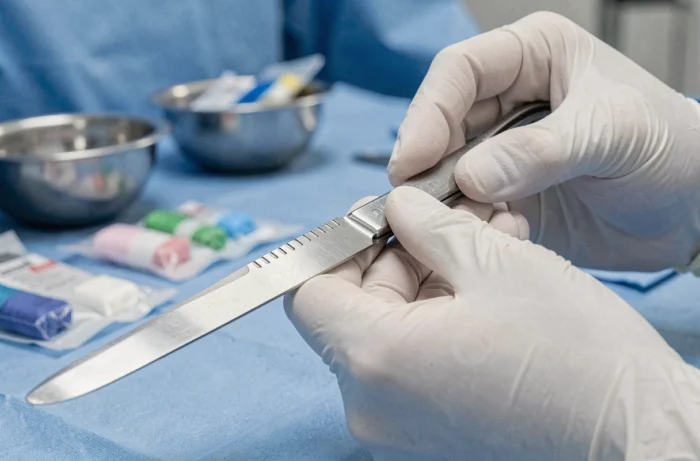
The scalpel consists of a reusable handle and an interchangeable blade. The most common handle accepts blades of various shapes, chosen according to the type of tissue to be incised. The blade is mounted and removed with forceps, never by hand, to avoid blood exposure accidents.
Single-use blades now represent a growing share of the market. The segment of single-use surgical devices is progressing across all specialties, driven by the demands for controlling nosocomial infections.
Surgical Scissors
Mayo scissors, robust in design, are used to cut thick tissues and sutures. Metzenbaum scissors, finer and longer, are reserved for dissecting delicate tissues. Confusing their uses damages the blades and compromises the precision of the act.
- Mayo scissors: cutting sutures, fascia, and resilient tissues. Short, thick blades.
- Metzenbaum scissors: fine dissection of tissue planes. Long, tapered blades.
- Potts scissors: vascular cutting, with a specific angulation for arteries and veins.
Surgical Forceps: Grasping and Hemostasis
Forceps represent the broadest category of surgical instrumentation. They are divided into two distinct functional groups.
Grasping Forceps
Dissection forceps manipulate tissues without crushing them. Claw models (such as Adson) firmly grasp the skin and fascia during suturing. Models without claws (such as DeBakey) are preferred for fragile tissues, particularly in vascular surgery.
The choice between clawed forceps and atraumatic forceps directly depends on the tissue being manipulated. Using clawed forceps on a blood vessel would cause wall damage.
Hemostatic Forceps
Hemostatic forceps, or clamps, are used to compress a vessel to stop bleeding. The Kelly clamp and the Kocher clamp are the most common. The Kocher clamp has claws at its end, providing a more aggressive grip suitable for fibrous tissues.
The market for hemostatic forceps remains structured around historical manufacturers, but single-use versions are gaining ground in operating rooms where reprocessing in sterilization poses logistical constraints.
Retractors and Needle Holders: Access and Closure
Once the incision is made and bleeding controlled, the surgeon needs a clear field of vision. This is the role of retractors.
Manual and Self-Retaining Retractors
Manual retractors (Farabeuf, Langenbeck) are held by an assistant who continuously adjusts the exposure. Self-retaining retractors (Balfour for the abdomen, Weitlaner for superficial tissues) lock in position and free the hands of the team.
- Farabeuf: two-ended retractor, used in pairs for superficial incisions.
- Balfour: self-retaining abdominal retractor with a removable suprapubic blade.
- Weitlaner: self-retaining retractor with claws, suitable for muscular and subcutaneous planes.
Needle Holders
The needle holder grips the curved needle to perform sutures. The Mayo-Hegar model, the most common, features a ratchet system that locks the grip. The choice of needle holder depends on the size of the needle and the depth of the surgical field.
Suture threads are classified into absorbable and non-absorbable. Absorbable threads are preferred for deep layers, while non-absorbable ones are used for skin or structures subjected to prolonged tension.
Sterilization and Maintenance of Reusable Instruments
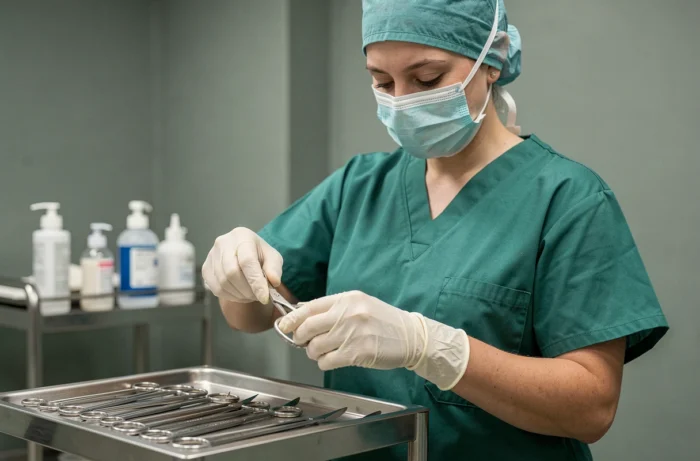
A reusable surgical instrument retains its properties only if it is properly reprocessed. The sterilization cycle includes cleaning, disinfection, and autoclaving.
A malfunctioning sterilizer can lead to the postponement of scheduled procedures, as illustrated by recent incidents in Canadian hospitals where administrative delays delayed the recommissioning of sterilization equipment in the operating room.
Preventive maintenance of instruments (sharpening scissors, checking ratchets, aligning jaws) extends their lifespan and preserves the precision of the act. A poorly sharpened scissor forces the surgeon to exert more pressure, increasing tissue trauma.
The choice between reusable and single-use instruments is not merely a question of unit cost. It must integrate the cost of reprocessing, the risk of cross-contamination, and the logistical constraints specific to each establishment. A single-use instrument eliminates the risk of incomplete sterilization, but generates a volume of waste that operating rooms must manage in an increasingly environmentally pressured context.