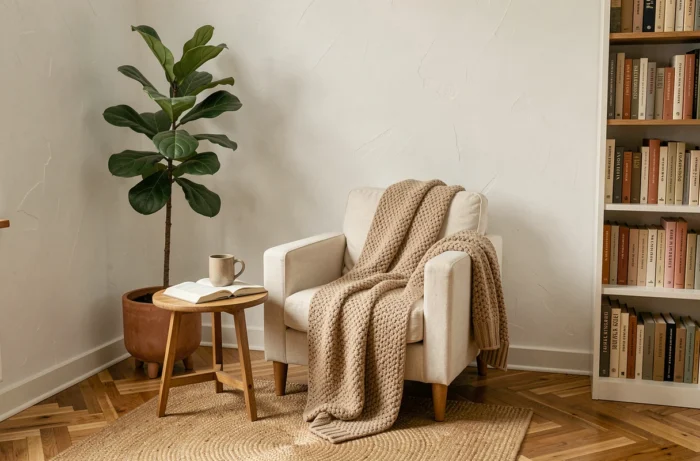
Cocooning in 2026 is no longer just about piling blankets on a sofa. The European regulation on formaldehyde emissions, which comes into effect on August 6, 2026, with Regulation (EU) 2023/1464, changes the game for anyone renovating or refurnishing their interior. Transforming a space into a trendy cocoon now requires balancing aesthetic requirements with air quality.
Formaldehyde and cocooning furniture: what the REACH regulation imposes in 2026
The new threshold set by entry 77 of Annex XVII of REACH caps formaldehyde emissions at 0.062 mg/m³ of air for wood-based furniture and panels. For broader interior items (foams, laminates, appliance casings), the limit is 0.080 mg/m³.
In practice, this means that cheap MDF bookshelves, untreated particleboard dressers, or low-end laminated headboards may disappear from the European market if they do not meet these limits. A cocoon interior therefore requires certified low-emission panels, solid wood, or alternatives like rattan, lacquered metal, or plant-based leather without polluting foam.
We recommend systematically checking the technical sheet of the furniture before purchase. The mention E0.5 or Super E0 on a particle board panel generally guarantees compliance with the REACH threshold. Without this indication, it’s better to pass, even if the furniture ticks all the aesthetic boxes.
For those who wish to discover the home section of Blog VIP, the approach precisely combines furniture selection and air quality criteria, a reflex still rare in mainstream decor media.
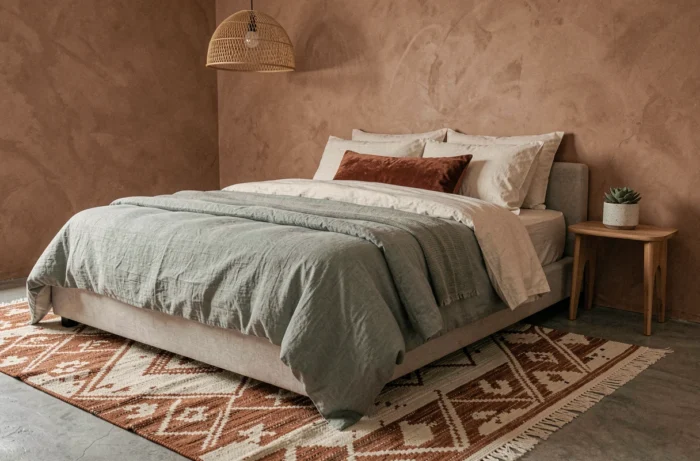
Cocooning color palette: going beyond beige and terracotta
Neutral tones remain the foundation of a cocooning living room, but the 2026 trend pushes for less expected combinations. Sage green, deep chocolate brown, and slate blue work as anchor colors capable of structuring a room without closing it off.
The matte/satin contrast is as important as the hue itself. A wall painted in matte sage green paired with a satin velvet sofa in a neighboring tone creates a visual depth that two identical matte surfaces do not achieve. This play of finishes advantageously replaces the accumulation of colors.
On the walls, textured wallpaper (plant fiber, plaster effect, tone-on-tone pattern) is making a strong comeback. It adds a tactile dimension that paint alone does not provide, while also serving as a lightweight sound insulator in open spaces.
Combining colors and materials without overloading
The rule of three materials per visual zone remains a reliable guideline: one dominant material (sofa fabric), one secondary material (wood from the TV unit or coffee table), one accent material (brass from a lamp, ceramic from a vase). Beyond this, the space loses readability and the cocoon effect turns into chaos.
- Light wood + washed linen + brushed brass for an updated Scandinavian vibe
- Dark walnut + cream boucle + black stoneware for a contemporary and enveloping living room
- Natural rattan + thick dyed cotton + glazed terracotta for a Mediterranean take on cocooning
Lighting and thermal comfort: the two underestimated levers
Poorly thought-out lighting sabotages any cocooning decor. Cold white light (above 4,000 K) is incompatible with an enveloping atmosphere. We observe that the ideal color temperature is between 2,200 and 2,700 K for ambient lighting in the living room and bedroom.
Multiplying light sources is better than installing a single ceiling fixture. Three variable-intensity light points (reading lamp, indirect floor lamp, string lights or low wall sconce) are enough to modulate the atmosphere of a standard-sized room.
The thermal dimension of the cocoon
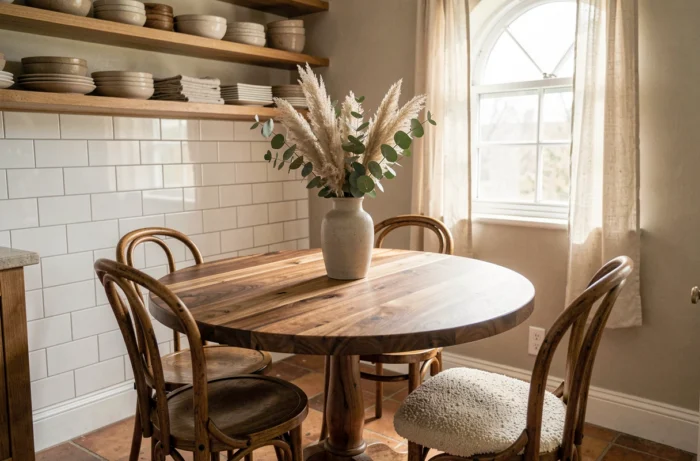
A cocooning interior that registers 18 °C in winter does not keep its promise. The comfort felt depends as much on the radiant temperature of the walls as on the air temperature. A thick rug on a tiled floor, a lined curtain in front of a single-glazed window, or a merino wool throw on an armchair are not just decorative accessories: they are thermal correctors that increase the perceived temperature without touching the thermostat.
The textiles to prioritize for this effect:
- Boucle or merino wool for throws, with a sufficiently dense weight to provide real insulation
- Brushed cotton or flannel for bed linen, warmer to the touch than percale cotton
- Jute or woven wool for rugs, which cut the thermal bridge from the floor
Cozy decor and forgotten spaces: entryway, hallway, bathroom
The majority of articles on cocooning focus on the living room. However, the entryway and hallway are the first spaces traversed when entering one’s home. A cocoon begins at the front door.
A narrow bench with a linen cushion, a solid wood coat rack, and a wall sconce at 2,500 K transform a passageway into a decompression zone. The cost remains modest, but the impact on the perception of the entire home is disproportionate.
In the bathroom, cocooning involves using natural materials resistant to humidity: oiled teak for a stool or shelf, long-fiber organic cotton towels, woven wicker basket. Avoid accessories made from uncertified MDF panels, especially since the new REACH limits on formaldehyde also apply to small bathroom furniture often overlooked.
The true marker of a successful cocooning interior is not the quantity of accumulated objects, but the coherence between physical comfort, air quality, and visual pleasure. Every room, even the smallest, deserves to be evaluated with this lens before adding a single cushion.