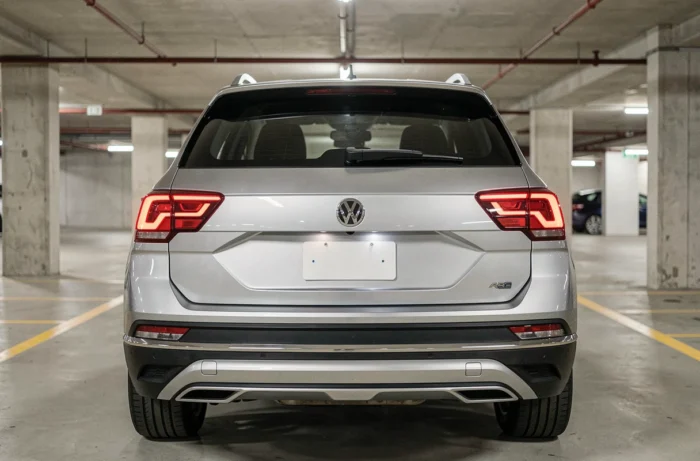
The second generation of the Volkswagen T-Roc repositions the rearview camera not just as a comfort accessory, but as a central sensor in a coherent ADAS architecture. We observe a change in philosophy in the 2026 configurations: the rear image now feeds multiple subsystems simultaneously, altering how the vehicle manages low-speed maneuvers.
T-Roc 2026 Rearview Camera: Sensor Fusion and ADAS Architecture on MQB evo Platform
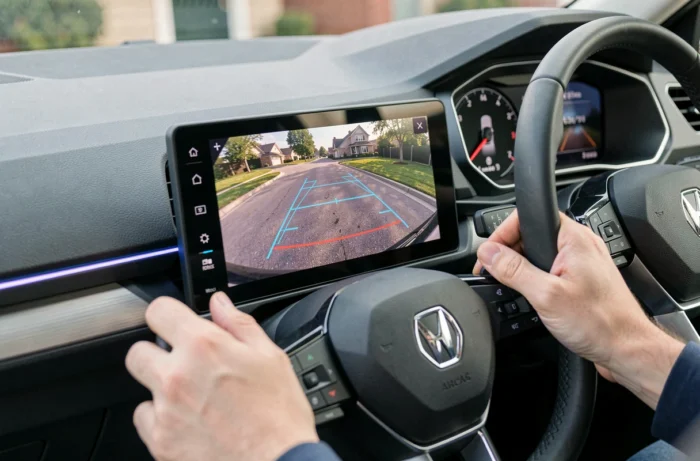
The MQB evo platform centralizes the processing of video and radar streams in a single computer on the second-generation T-Roc. The rearview camera no longer just displays an image on the central screen. It provides real-time data to the Rear Traffic Alert and exit warning system, creating a layer of software correlation absent in previous models.
This fusion reduces the latency between obstacle detection and the triggering of an audible or haptic alert. Previously, the rear camera and ultrasonic sensors operated in parallel, without data crossover. The MQB evo computer now combines the camera stream with that of the Side Assist to expand the monitored perimeter during parking maneuvers in angled or parallel positions.
We recommend buyers check for the complete IQ.DRIVE package. This is what activates the multi-sensor correlation. Without this package, the rearview camera remains operational but loses the layer of intelligence that makes a difference in dense urban environments. The innovations of the T-Roc rearview cameras make sense when placed within this logic of global integration.
Area View 360°: An Aerial View Becoming Commonplace on Compact SUVs
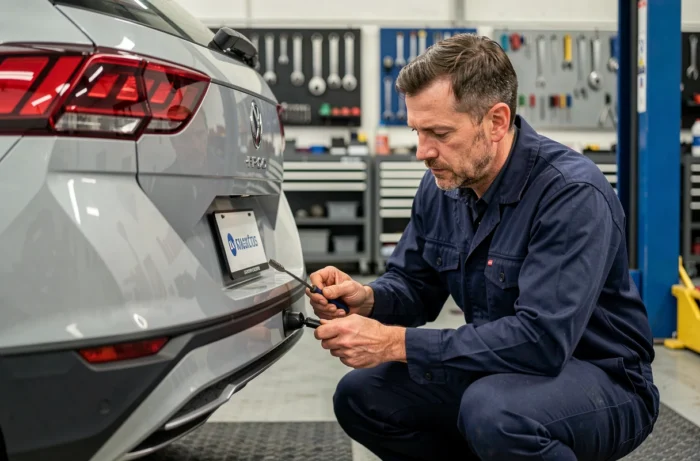
The T-Roc 2026 can be equipped with an Area View system that provides a 360° aerial view through several cameras distributed around the vehicle. This type of functionality already existed in the premium segment. Its arrival on a compact SUV at this price point changes the game for direct competitors.
The operation relies on the complementarity between the rearview camera and ultrasonic sensors. The sensor/camera redundancy significantly reduces the risk of collisions compared to systems relying solely on ultrasonic sensors. We observe that this dual-source information architecture improves detection reliability, particularly in underground parking where lighting conditions complicate the work of the camera alone.
Standard Rearview Camera on Life Trim: Impact on the Used Car Market
The key highlight for 2026 is the standardization of the rearview camera and Park Assist with front/rear sensors from the entry-level Life trim. Volkswagen’s strategy aims to make these features standard rather than an option reserved for higher trims.
Consequences on Residual Value
For the used car market, the effect is direct. A first-generation T-Roc without a rearview camera loses attractiveness compared to 2026 models that include it as standard. Dealerships will likely need to adjust their pricing grids for resale.
The other consequence affects competitors in the compact SUV segment. A rival model lacking a standard camera finds itself at a perceived disadvantage, even if its dynamic performance remains comparable. The rearview camera becomes a daily choice criterion, not a secondary selling point.
Exit Warning and Cyclist Detection: The Rearview Camera Serving Active Safety
The exit warning system directly utilizes the rear camera stream. When the vehicle is stationary and an occupant is about to open a door, the rear and side sensors scan the environment. If a cyclist or vehicle approaches, the system emits a visual and audible alert.
The rearview camera covers the rear area that the side radars do not fully capture. The centralized computer of the MQB evo platform fuses these streams in real-time, enabling this complementarity without perceptible latency.
- Rear Traffic Alert: detection of approaching vehicles during reversing maneuvers, with automatic braking if the driver does not react
- Side Assist: monitoring of blind spots at higher speeds, which remains active even when stationary for exit warning
- Exit warning: visual and audible alert in case of detection of a vulnerable road user approaching from the rear or side
It is this pooling of sensors that distinguishes the T-Roc 2026 from its predecessors, where each function operated in isolation. All subsystems share data from the rearview camera, making the architecture more responsive and coherent.
For buyers comparing compact SUVs, the question has changed in nature. It is no longer about whether the vehicle has a rear camera, but how this camera interacts with the rest of the onboard electronics. The IQ.DRIVE package remains the benchmark that separates a simple parking aid from a true active safety ecosystem.